VÚB a.s. and UWB are helping to develop smart sleeves for astronaut Aleš Svoboda
CLUTEX - cluster of technical textiles presents the achievements of its members.
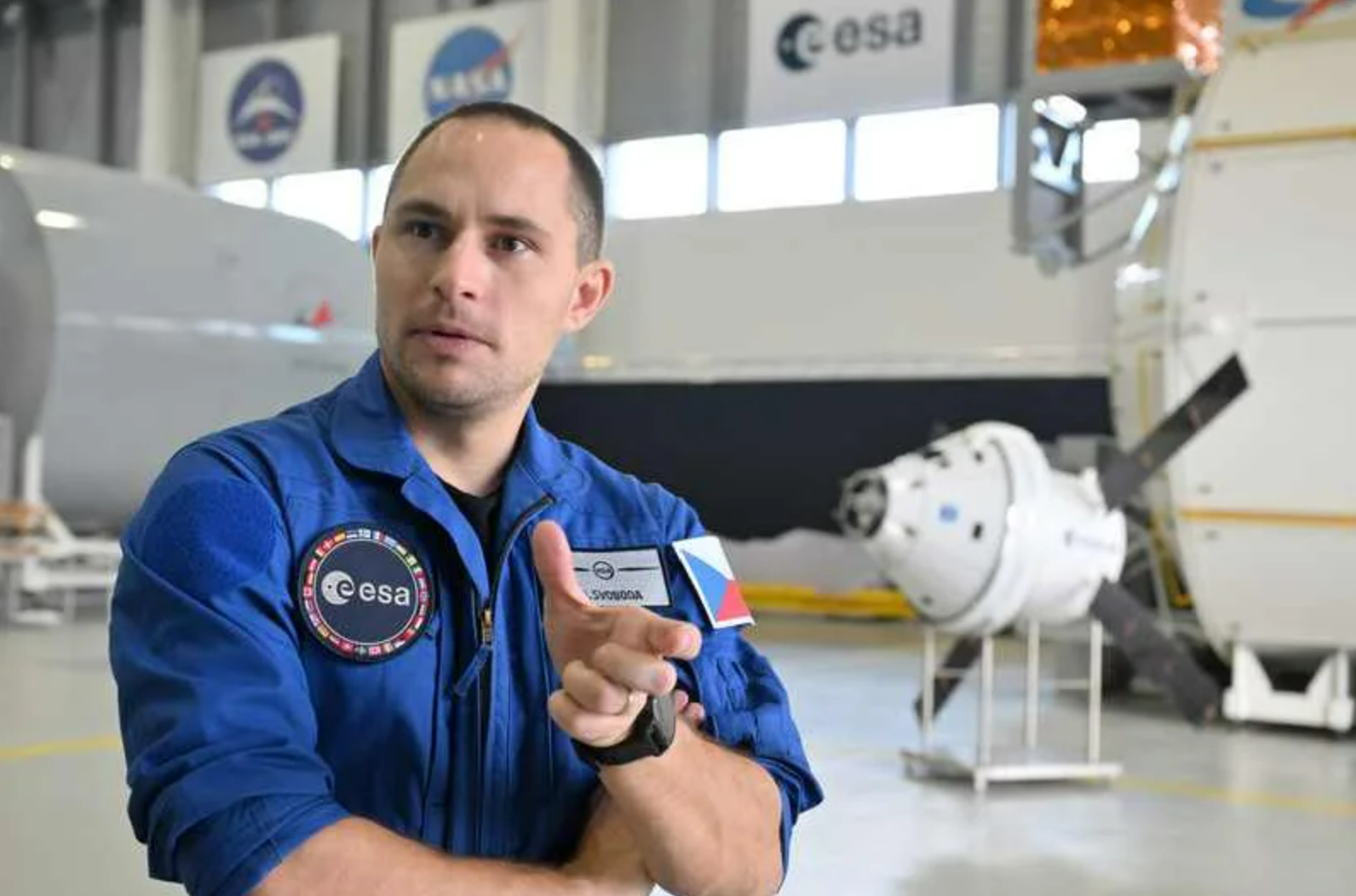
As early as the end of 2027, Czech astronaut Aleš Svoboda could travel to the International Space Station (ISS). He plans to take 13 scientific experiments from universities and research institutions in the Czech Republic. One of these experiments also involves researchers from VÚB a.s. and the Faculty of Electrical Engineering at the University of West Bohemia (UWB).
Astronauts can lose up to 30% of their muscle mass within a single month in microgravity (Williams et al., 2009). This significantly reduces their performance and safety when returning to Earth. Researchers from VÚB a.s. and the Faculty of Electrical Engineering at UWB in Pilsen, together with colleagues from the Czech Technical University in Prague and G. L. Electronics, have therefore focused on developing the AstroMoWe experiment—a smart textile system that will monitor astronauts’ muscle activity aboard the ISS. The technology will also have benefits for life on Earth.
It is a wearable system that combines the measurement of muscle electrical activity (EMG) with motion tracking and data analysis using artificial intelligence. Four lightweight electronic units are placed on the astronaut’s limbs to monitor muscles that weaken the most in weightlessness. The system continuously evaluates signals from the monitored muscles. Data are stored in internal memory, and the units are powered by batteries lasting up to one week with half-day operation.
Among those involved in the development is Tomáš Blecha, the project leader on the Pilsen side. UWB’s contribution lies primarily in the development of smart textiles. “At the Faculty of Electrical Engineering of UWB, we develop textile electrodes and participate in integrating the system into textile sleeves that astronaut Aleš Svoboda will use on the ISS,” says Tomáš Blecha. Students are also involved in the project, working mainly on embroidering electrodes using automated embroidery machines and conducting laboratory testing of materials. “For them, it is a unique experience—they are contributing to the development of a technology that is heading into space,” adds Radek Soukup.
At UWB, textile electrodes are being developed using hybrid conductive threads that combine gold-plated molybdenum wires with flame-retardant aramid fibres developed in cooperation with VÚB a.s. in Ústí nad Orlicí. “Conventional electrodes are attached directly to the skin and may cause irritation, whereas the developed textile is breathable, comfortable, and easy to use—the astronaut simply puts it on like a regular sleeve.” A key innovation from UWB is the electrode design itself, its adaptation for obtaining high-quality muscle signals, and the optimisation of the embroidery machine’s technological parameters.
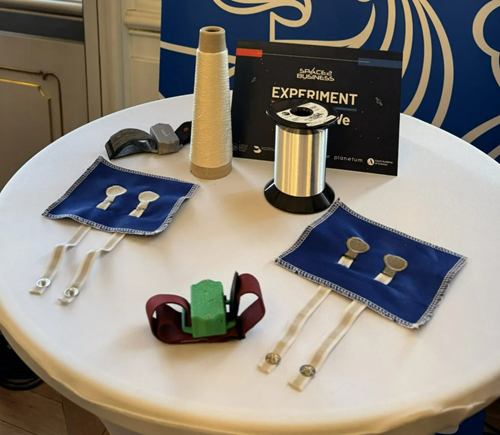
A key innovation from VÚB a.s. is the development of a special textile sleeve made of flame-retardant material that ensures reliable fixation of both electrodes and electronics, offers high user comfort, and allows the astronaut to put it on and take it off without assistance. At the same time, it will be extremely lightweight - every gram saved is crucial in space for handling as well as for the cost of transport from Earth to the ISS.
“For VÚB a.s., participation in this project is a major milestone. Developing textile materials for a manned space mission is a challenge, but also confirmation that Czech textile research is of a high international standard,” says Vladimír Kubový, researcher at VÚB a.s.
Miroslav Tichý, Head of Research in Special Textiles, adds:
“The most important task was to develop a yarn that meets the strict safety requirements of the European Space Agency (ESA), is durable, conductive, and comfortable to wear. The combination of comfort and functionality is essential for astronauts - and this is precisely where we as textile developers can excel.”
Thanks to AstroMoWe, scientists will be able to better understand changes in muscle activity in microgravity and optimise astronaut training. Equally important, however, is its impact on everyday life on Earth - the technology has applications in rehabilitation, sports medicine, elderly care, and injury prevention.
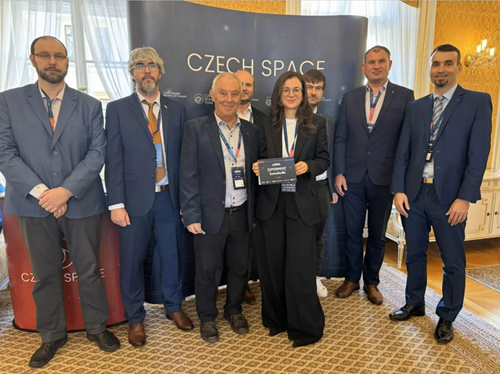
The AstroMoWe experiment (Astronaut Muscle and Movement Wearable Monitoring System) was developed in cooperation with the European Space Agency (ESA). It was presented to the public on 21 October 2025 at a press conference during Czech Space Week at the Liechtenstein Palace in Prague. The project partners include the Czech Technical University in Prague (main coordinator), the University of West Bohemia (development of textile electrodes), VÚB a.s. (textile materials), and the Brno-based company G. L. Electronic s.r.o. (manufacture and testing of electronics in cleanroom environments).
Prepared by a team from the University of West Bohemia in Pilsen and VÚB a.s. in Ústí nad Orlicí.
CLUTEX – the Technical Textiles Cluster has long been collaborating with partners on joint projects. At Cluster Day in the Pilsen Region, held on 22 October, the cluster presented the results of a CORNET programme project in the Technology Village. The project focused on the development of new technologies for ultrasonic and thermocompression contacting, as well as advanced methods for the encapsulation of textile conductors.